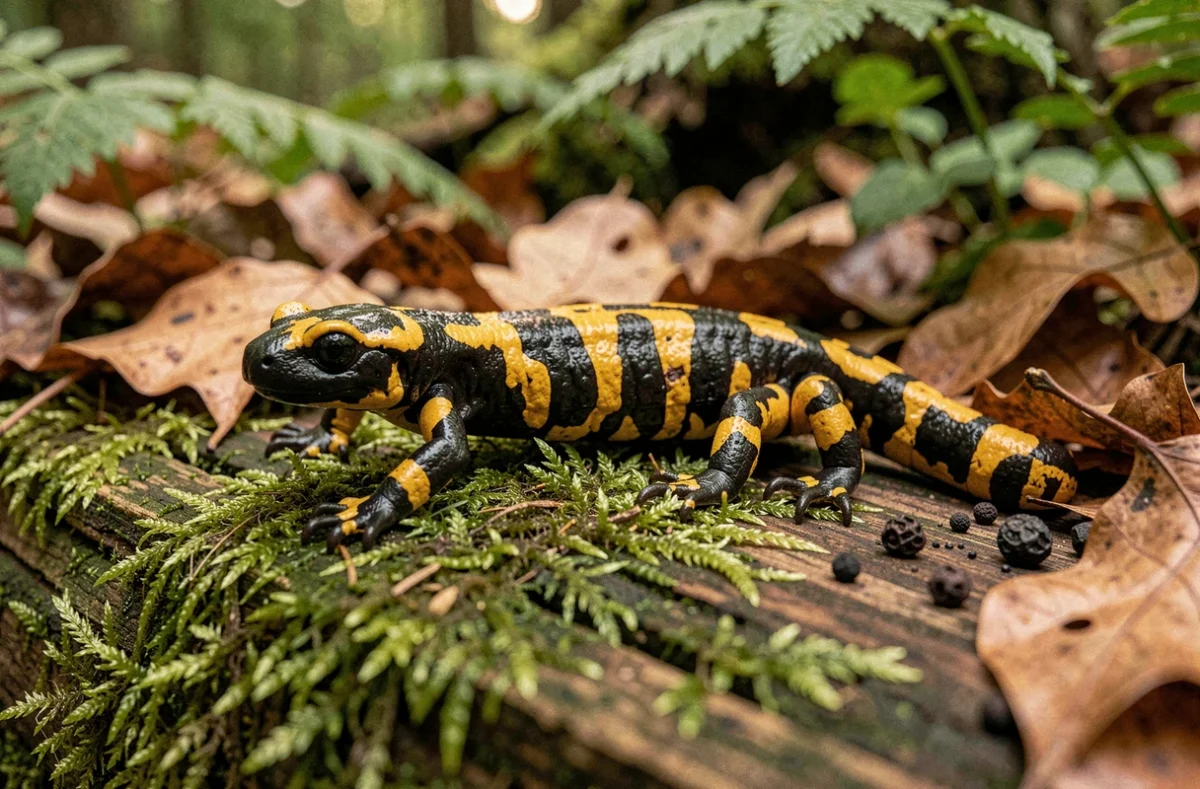
On a damp forest path, you sometimes come across small dark piles, barely visible among the dead leaves. When you know that a spotted salamander frequents the area, the temptation is strong to confirm its presence through its droppings. Salamander droppings, although discreet, provide valuable information about the animal’s diet, health, and even genetics.
Diet of the salamander: what its droppings reveal
Before discussing identification, it’s beneficial to understand what these droppings are made of. The spotted salamander (Salamandra salamandra) primarily feeds on earthworms, slugs, flies, beetles, and millipedes. This diet varies according to the season, altitude, and humidity of the environment.
The concrete result: the appearance of the droppings changes according to the ingested menu. An individual that primarily consumes worms produces softer and darker droppings. Another, fed on beetles, leaves residues where fragments of elytra or shells can sometimes be distinguished under a binocular microscope.
You can also understand salamander droppings as a direct reflection of the quality of the biotope. A forest soil rich in invertebrates provides a diverse diet, which results in heterogeneous droppings. Conversely, in a depleted environment, the food spectrum narrows and the droppings become more uniform.
Identifying salamander droppings in the field
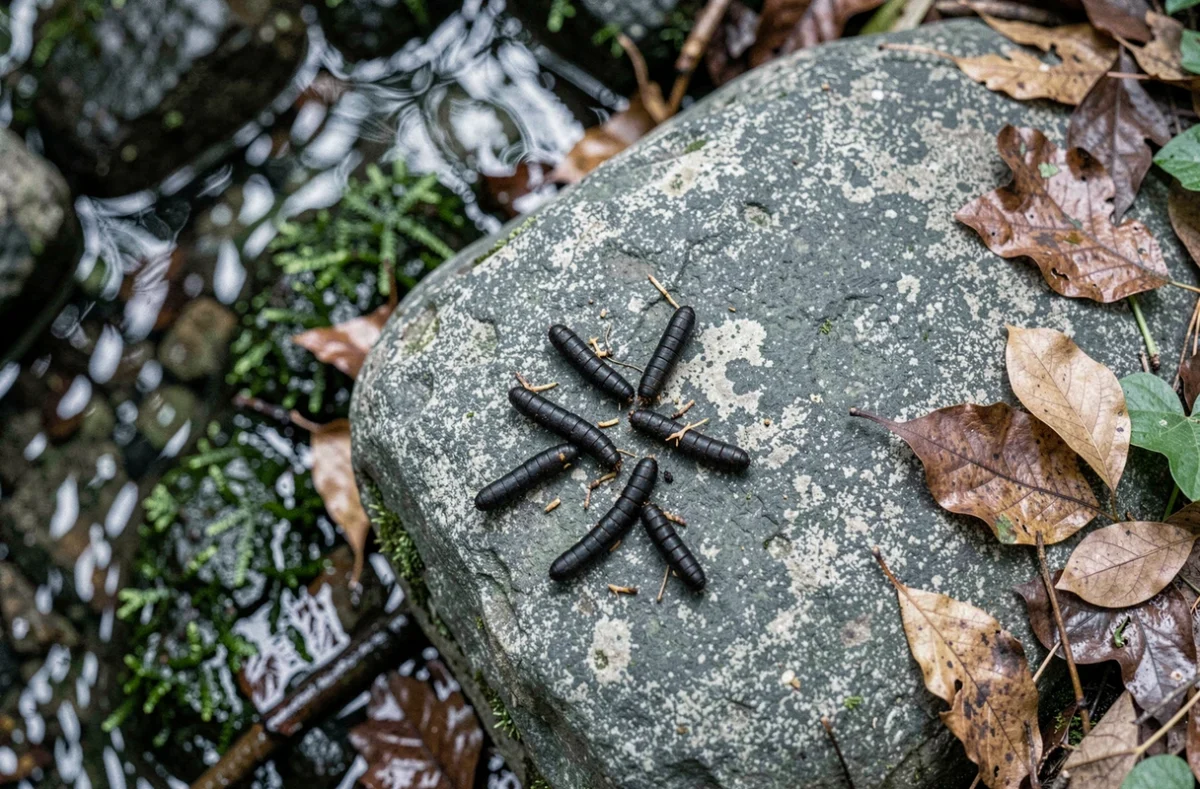
In the field, you often encounter a small blackish cylinder, a few millimeters in diameter, lying on the litter or under a stone. The problem is that the droppings alone are not sufficient to identify a salamander. They resemble those of other small amphibians, or even some invertebrates.
To ensure reliable identification, several clues are cross-referenced:
- The immediate habitat: the spotted salamander frequents humid deciduous forests, shaded stream banks, and cavities under stones or dead wood.
- Signs of passage: mucus trails on stones, four-toed footprints on soft ground, presence of larvae in nearby water points.
- The activity period: adult salamanders primarily emerge during rainy weather, at night, especially in autumn and spring depending on the regions.
Without this cross-referencing, there is a risk of confusing the droppings with those of a newt, a small toad, or even a large carabid beetle. In case of persistent doubt, only a laboratory analysis can provide a definitive answer.
Environmental DNA in droppings: a non-invasive monitoring technique
Salamander droppings are increasingly of interest to biologists for a specific reason: they contain exploitable DNA. This is referred to as environmental DNA (eDNA), which is the genetic material left by an organism in its environment, whether in water, soil, or feces.
Species detection without capture
The main advantage of this approach is to detect the presence of a species that is difficult to observe without handling it. A fecal sample is collected in the field, analyzed in the laboratory, and a positive result confirms the recent passage of a salamander at the site.
This method reduces stress inflicted on animals and avoids the constraints associated with capture. It complements traditional inventories (night surveys, larval counts), but does not entirely replace them. Feedback on this point varies, as risks of cross-contamination, transport of DNA through runoff water, or biases related to the genetic primers used can skew results.
Health monitoring through fecal analysis
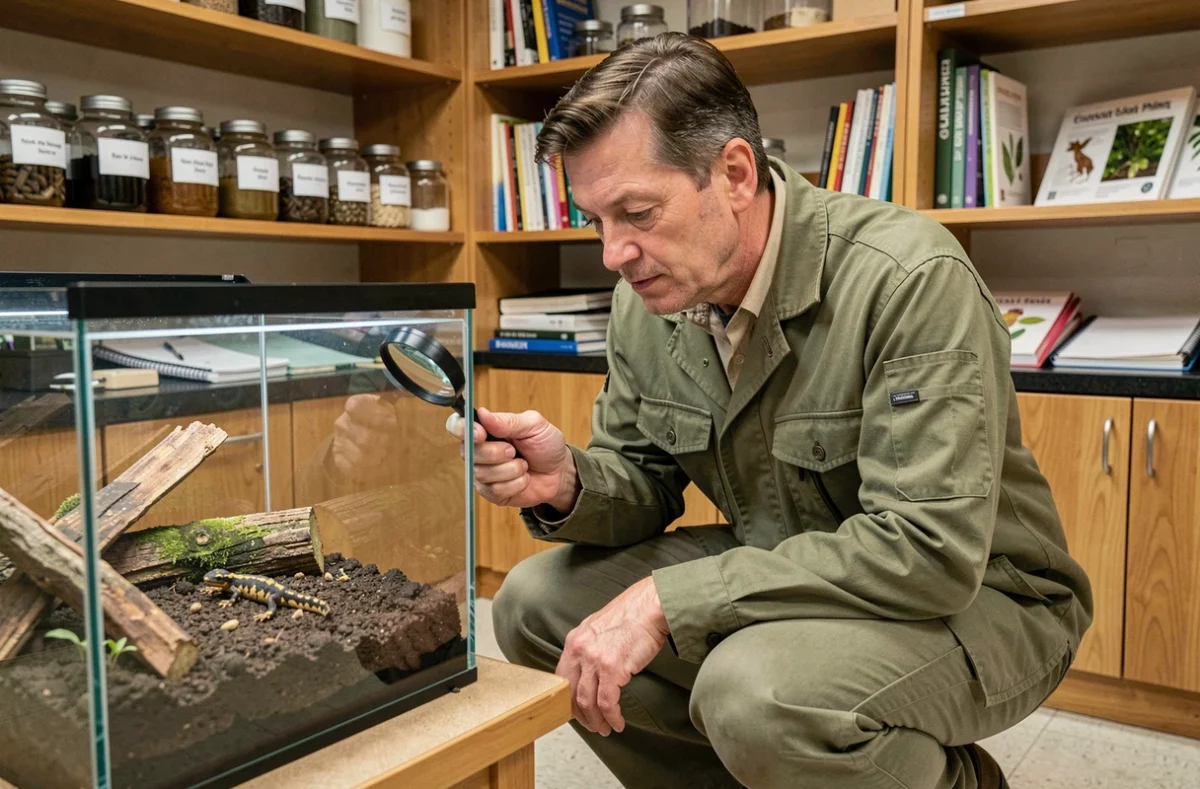
Beyond simple detection, fecal samples allow for the search for parasites or pathogens. This includes the fungus Batrachochytrium salamandrivorans (Bsal), responsible for chytridiomycosis, a disease that decimates entire populations of urodeles in Europe.
Analyzing droppings rather than capturing the animal limits the risks of spreading between individuals during handling. However, a positive PCR result indicates the presence of targeted pathogen DNA, not necessarily an active disease. Interpretation remains cautious.
Ecological role of droppings in the forest ecosystem
One does not spontaneously think of salamander droppings as a link in the nutrient cycle in the forest. Their individual contribution remains modest, but it fits into a larger network.
By digesting soil invertebrates, the salamander transforms animal biomass into partially decomposed organic matter. Its droppings, deposited under stones or in the litter, are then recycled by microorganisms, fungi, and detritivores. This process contributes to the fertility of humid forest soils where these amphibians live.
Adult salamanders occupy a limited territory. Their excrement therefore concentrates in specific micro-zones, which can locally create small points of soil enrichment in nitrogen and phosphorus. In deciduous forests, where the litter decomposes slowly under dense cover, this additional input, even minimal, aids in the recycling of organic matter.
Legal protection and field precautions
In France, the spotted salamander is protected. Handling an individual or disturbing its habitat is prohibited without specific authorization. This constraint also indirectly applies to the collection of droppings in a scientific context: a sampling protocol must comply with current regulations on protected species.
In the field, some precautions are necessary:
- Wear disposable gloves to avoid transmitting pathogens between sites (Bsal spreads easily via contaminated equipment).
- Disinfect boots and small equipment between two survey areas, especially if working near water points where larvae live.
- Avoid repeatedly turning over stones or dead wood: each disturbance temporarily destroys a micro-habitat.
Observing salamander droppings without disturbing the animal or its environment is the basis of respectful monitoring. The data collected, even by amateur naturalists, feeds into regional biodiversity databases and contributes to mapping the species’ distribution in French forests.