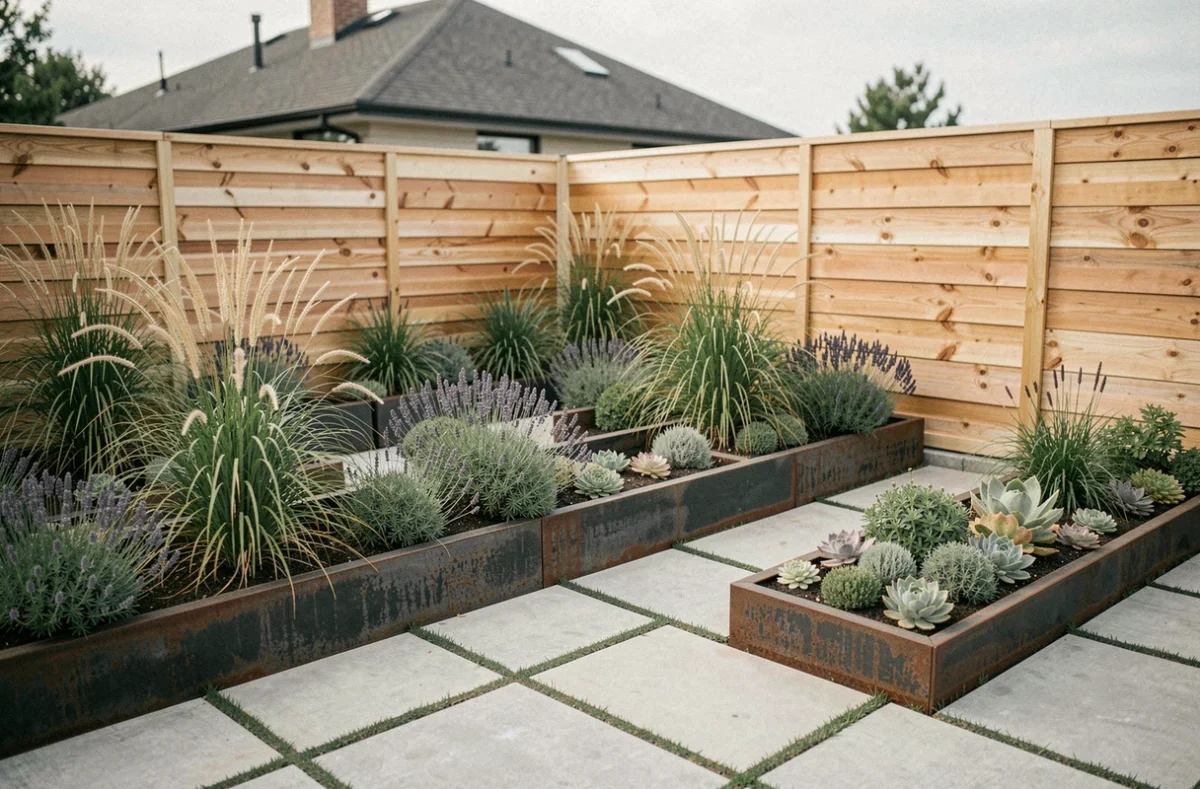
The contemporary garden is characterized by clean lines, raw materials, and a controlled plant palette. Documented trends for 2025 confirm a shift towards water-efficient designs, less dependent on lawns, where ground covers and local species replace traditional grass.
The Local Urban Plan (PLU) may impose constraints on permeable surfaces or fence heights even before the first spade is struck. Here are ten concrete levers to transform an ordinary outdoor space into a contemporary area, without excessive work.
1. Replace the lawn with persistent ground covers
Short grass, which is water-hungry and requires mowing, does not align well with contemporary spirit. Ground covers like creeping thyme, blue fescue, or Dichondra repens create a dense carpet that requires little maintenance.
In areas subject to drought restrictions, watering lawns may be prohibited. Choosing ground covers suited to the local climate from the outset eliminates this risk and reduces water bills in the long term.
For successful planting, it is better to plant in the fall to allow roots to establish before summer. Spacing plants fifteen to twenty centimeters apart is generally sufficient to achieve full coverage in two seasons.
2. Structure the space with contrasting mineral materials
The contemporary garden derives its character from the contrast between plant and mineral. Light gravel, smooth concrete slabs, slate stepping stones: each ground surface visually delineates distinct areas without resorting to prominent borders.
The goal is to limit the number of materials to two or three to maintain a clean aesthetic. A main paving, a filling gravel, and wood for the terrace cover most configurations. Multiplying finishes muddles the overall coherence.
Before choosing, it is useful to check the PLU regulations: some municipalities impose a minimum proportion of permeable surfaces, which may steer the choice towards stabilized gravel rather than poured concrete.
For those who wish to create a contemporary garden at home with a coherent overall plan, the choice of materials constitutes the first structuring decision.
3. Install a rainwater harvesting tank dedicated to irrigation
The decree of July 12, 2024 updates the health framework for the use of water unsuitable for human consumption. For outdoor use limited to irrigation or cleaning, a tank separate from the drinking water network remains the simplest case.
During drought crises, certain measures provide an exception for harvested rainwater. Designing an irrigation circuit fed by this reserve from the start makes the setup more robust than a simple timer connected to the network.
Buried or above ground, the tank is sized based on the connected roof area and the estimated irrigation volume. Field feedback varies on the ideal volume, but a capacity sufficient to cover several weeks without rain remains a reasonable benchmark.
4. Choose ornamental grasses as a unifying plant element
Miscanthus, Stipa tenuissima, Pennisetum: grasses bring movement and light verticality without excessive mass. They remain decorative even in winter thanks to their dried spikes.
Planted in repetition along a path or at the back of a bed, they create a visual rhythm typical of contemporary design. Their maintenance is limited to an annual trim at the end of winter.
5. Integrate recessed low-voltage lighting
Lighting transforms the perception of a garden as dusk falls. LED spots recessed into the terrace, along pathways, or at the base of a sculptural tree are enough to create an ambiance without overcrowding the space.
Low voltage (12 V) simplifies installation and reduces electrical risk in damp environments. Solar lights, on the other hand, provide a less powerful and less reliable output in less sunny regions.
A simple principle guides placement: illuminate materials and plants, not the visitors’ eyes. Directing beams downwards or grazing avoids glare and sculpts volumes.
6. Create a minimalist water feature
A Corten steel basin, a water blade integrated into a wall, or a simple rectangular concrete pond adds a sensory dimension. The sound of water masks urban noise disturbances.
Field feedback varies on the actual maintenance of a closed-loop pond. Planning for a filter and a recirculation pump limits algae proliferation, even in small volumes.
7. Opt for composite or steel slat fences
Stained wood panels age poorly and require regular treatment. Composite slats (wood-resin) or powder-coated steel panels maintain their appearance for years without maintenance.
Points to check before purchase:
- The maximum height allowed by the PLU or subdivision regulations, often limited to two meters at the property line
- The color imposed in certain heritage or classified areas
- The spacing between slats if a louvered effect is desired, as it alters the actual level of screening
8. Design beds in geometric blocks
Contemporary beds abandon free forms in favor of rectangles, squares, or linear strips. Planting a single species per block enhances the graphic effect.
Combining a block of lavender, a block of grasses, and a block of low perennials creates a contrast of textures visible even from a distance. This principle also works in small gardens, provided the number of blocks is reduced rather than their size.
9. Set up an outdoor lounge area with streamlined furniture
Contemporary furniture favors straight lines, dark shades (anthracite, matte black), and durable materials: aluminum, high-density woven resin, untreated teak.
Three elements are sufficient to define a functional garden lounge:
- A coffee table or a bench integrated into a concrete wall
- Comfortable seating with removable water-repellent cushions
- A plant screen or lattice to delineate the space without closing it off
Concentrating furniture in a single area avoids the dispersive effect that disrupts the contemporary reading of the garden.
10. Plant a sculptural tree as a focal point
A cloud-pruned olive tree, a Japanese maple, or a dwarf umbrella pine anchors the gaze and provides scale to the garden. One well-placed tree is better than five randomly placed shrubs.
The choice of species depends on exposure, soil type, and expected adult size. Checking the mature spread avoids heavy corrective pruning in a few years.
Positioning this tree at the end of a perspective or offset from the main axis of the terrace creates a natural focal point that nighttime lighting can enhance.
Each of these ten suggestions operates in a different register: soil, plant, light, furniture, water. Combining them while keeping a limited palette of materials and colors remains the guiding thread of a coherent contemporary garden. The local PLU and the water constraints of the plot should be consulted in advance, as they guide choices that would be costly to correct later.