
Building a homemade lawn tractor lift raises a question rarely asked before cutting the first steel tube: what type of lifting mechanism offers the best compromise between manufacturing cost, load capacity, and actual safety under the machine? Commercial models, hydraulic cylinder setups, and manual winch systems do not measure up equally on these three criteria.
Hydraulic Cylinder, Winch, or Ramp: Comparison of Lifting Mechanisms
The choice of mechanism dictates everything else in the manufacturing process. Before drawing a plan, one must decide between three common options in self-construction.
| Criterion | Hydraulic Cylinder (Bottle Jack) | Manual Cable Winch | Fixed Inclined Ramp |
|---|---|---|---|
| Cost of Parts | Moderate (jack + fittings) | Low (winch + pulley) | Low (steel + bolts) |
| Useful Lifting Height | High, continuously adjustable | High, but slow | Limited to the angle of the ramp |
| Lateral Stability | Medium (single support point) | Good if vertically guided | Very good (support across the entire width) |
| Risk of Sudden Descent | Real without a backstop device | Low with ratchet | None (no moving mechanism) |
| Access to Cutting Deck | Excellent (machine elevated) | Excellent | Partial (side access only) |
The bottle jack hydraulic cylinder remains the most common in homemade constructions. It allows for fine height adjustment and complete access under the cutting deck. However, it is also the system most exposed to a sudden descent if the cylinder seal wears out or if the machine slips from the support point.
Building a homemade lawn tractor lift around a cable winch with a ratchet reduces this risk. The ratchet mechanically locks the load at each notch. The compromise lies in the slow ascent and the need for a guided vertical frame to avoid lateral swaying.
Lateral Stability and Backstop Device: The Two Critical Points
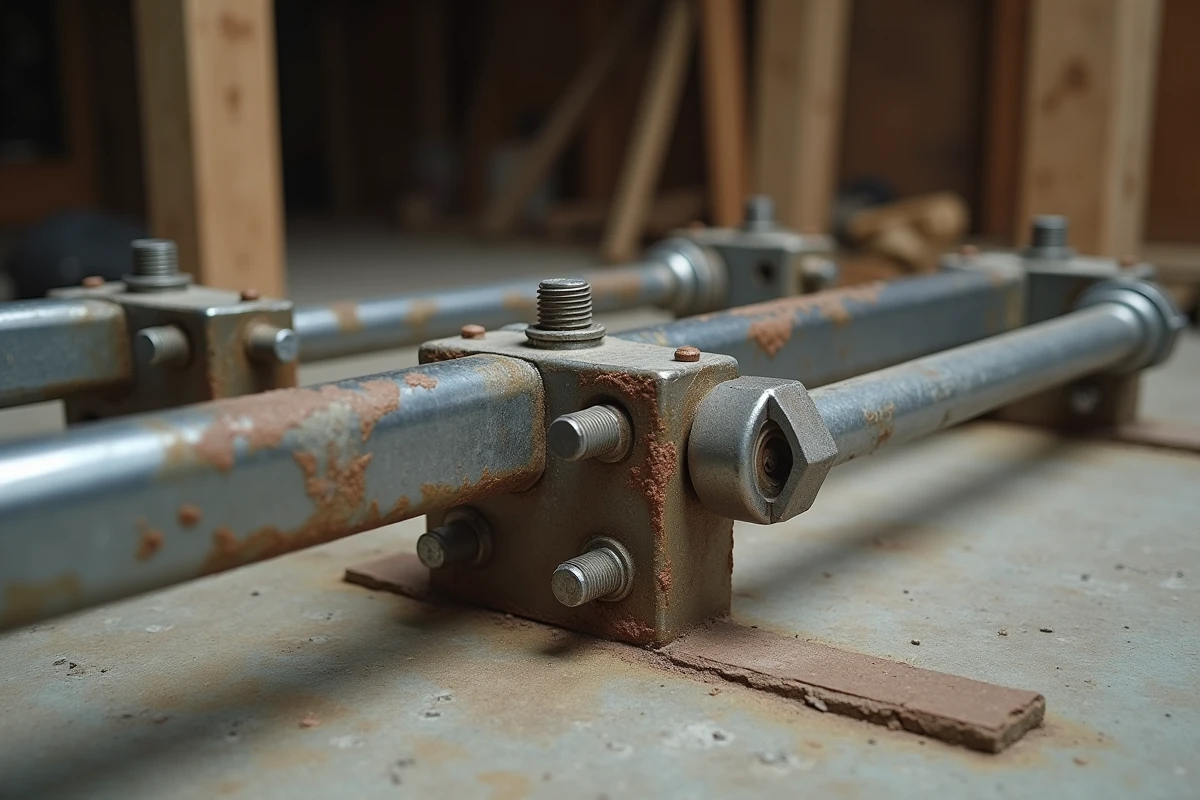
The European standard EN 1494:2020+A1:2023, revised and published in French by AFNOR in 2024, sets requirements for mobile lifting devices. It particularly addresses lateral stability and backstop devices. A homemade tractor lift is not subject to CE marking since it is not marketed, but this standard serves as a technical reference for prevention experts to judge whether a handmade design is reasonably safe.
Two defects frequently appear in accident reports analyzed by the prevention services of CARSAT and CRAMIF since 2023: insufficient bracing and poorly positioned support points under the chassis. The machine rarely falls due to a failure of the main mechanism, but rather due to lateral slipping of the tractor on uneven ground or a support that is too narrow.
Bracing and Support Width
A lifting frame with a base measuring at least the width of the tractor’s rear axle significantly limits the risk of tipping. Too narrow constructions, designed to take up little space in the garage, are the most dangerous.
- Place the tractor lift on a flat, hard surface (concrete slab, no dirt or gravel), otherwise the frame will sink asymmetrically under the load.
- Add a safety jack independent of the main lifting mechanism: if the cylinder fails, the jack will hold the machine.
- Ensure that the support point under the tractor’s chassis corresponds to a structural cross member and not to a body panel or the engine casing.
These three precautions directly address the criteria of the EN 1494 standard regarding redundancy of support and support surface.
Home Insurance and Homemade Tractor Lift: A Blind Spot
This point is often overlooked in most construction tutorials. Since 2024, several home insurers in France, notably Groupama and MAAF in their updated warranty notices for motorized garden equipment, specify that a lifting device made or modified by the insured, not compliant with a manufacturer’s manual or current standard, may result in exclusion from coverage in the event of bodily injury.
In practice, this means that if a household member is injured under the tractor lifted by a homemade device, the expert appointed by the insurer will examine the device’s compliance. The absence of a backstop device or safety jack is sufficient to characterize a lack of precaution.
How to Document Your Construction
Keeping a record of the chosen dimensions protects in case of disputes. Some elements to archive:
- The dimensioned plan of the frame with the sections of steel used (square tube, angle iron, thickness).
- The model and capacity of the cylinder or winch, along with the purchase invoice.
- Timestamped photos of the assembly and the tractor lift in a loaded position, showing the safety jack in place.
- The weight of the lawn tractor noted in the manufacturer’s manual.
A dated construction file does not guarantee coverage, but it demonstrates a precautionary approach that the expert can evaluate favorably.
Choice of Steel and Assembly: Welding or Bolting
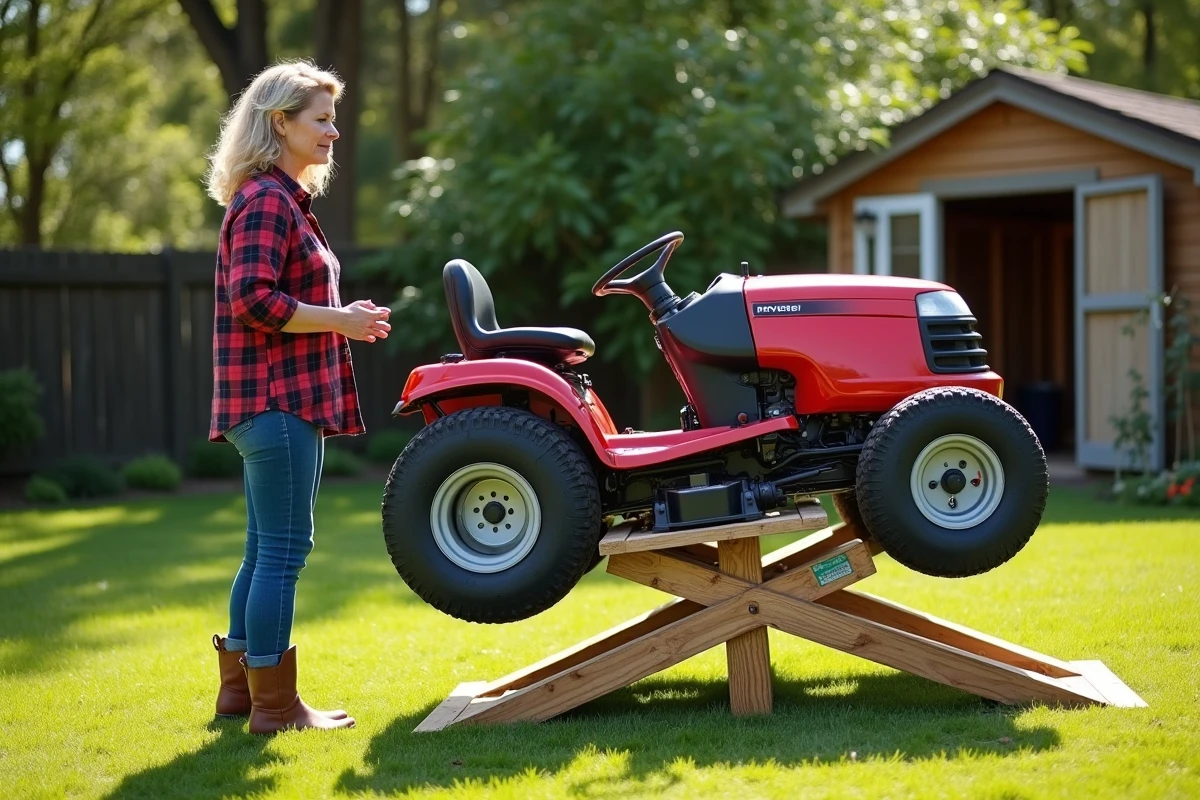
Square steel tubing is the most commonly used profile for homemade tractor lift frames. It offers good resistance to bending for a moderate weight. In contrast, angle iron alone lacks torsional rigidity as soon as the span exceeds the width of the machine.
Welded assembly produces a stiffer and more compact frame. Bolted assembly allows for disassembly and flat storage, which is important when the garage is tight. A mixed assembly (welded main frame, bolted legs) combines both advantages.
For welding, a MIG welder with flux-cored wire is sufficient on standard construction steel. The welds should cover the entire length of contact between the pieces, not just the ends. An interrupted weld divides the strength of the joint proportionally to the missing welded surface.
The weight of the lawn tractor, often indicated in the manufacturer’s manual, determines the minimum tube section. Designing the frame for at least one and a half times the weight of the machine leaves a margin for dynamic stresses during lifting.
Building your own lawn tractor lift remains an accessible project as long as stability and safety are treated as design constraints, not optional additions. The lifting mechanism, backstop device, and documentation of the assembly form a coherent set, none of which should be neglected.