
The speed at which you walk says more about your health than the number of steps displayed on your fitness tracker. Since March 2025, the High Authority of Health has included walking speed as an indicator of frailty in its assessment recommendations for seniors. This data, sometimes referred to as the “sixth vital sign,” deserves attention to understand what it measures, how to contextualize it, and which levers to act upon.
Walking speed and cadence: the thresholds that matter for health
The confusion between speed and cadence muddles the understanding of many walkers. Speed is measured in kilometers per hour, while cadence is measured in steps per minute. The two are related but not interchangeable: two people walking at the same pace can have very different cadences depending on their height and stride length.
| Type of walking | Indicative speed | Approximate cadence | Typical profile |
|---|---|---|---|
| Slow walking (leisure, hiking) | Less than 5 km/h | Less than 100 steps/min | Leisure, recovery, reduced mobility |
| Moderate walking | 5 to 6 km/h | 100 to 110 steps/min | Daily movements |
| Fast walking (sporty) | 6 to 8 km/h | 110 to 130 steps/min | Cardiovascular goal |
| Athletic walking | Above 8 km/h | More than 130 steps/min | Competition, intensive training |
The European regulation 2024/2017 on wearable medical devices now requires connected pedometers sold in Europe to display cadence in steps per minute as a priority metric. This regulatory choice reflects a finding: cadence is a more reliable health indicator than the distance covered.
To assess your own cadence, count your steps for one minute on flat ground, at your usual pace. A result around 100 steps per minute corresponds to a moderate pace. To achieve significant cardiovascular effects, aiming for a range of 110 to 120 steps per minute is a realistic and measurable goal.
To explore normal speed benchmarks according to age and profile, you can walk healthily with Valbreon and situate your pace relative to observed averages.
Heart rate during walking: the true marker of intensity
A speed figure alone tells nothing without physiological context. Two walkers at 6 km/h do not have the same cardiac load if one is sedentary and the other has been training for months. Heart rate during exertion remains the best indicator of actual intensity.
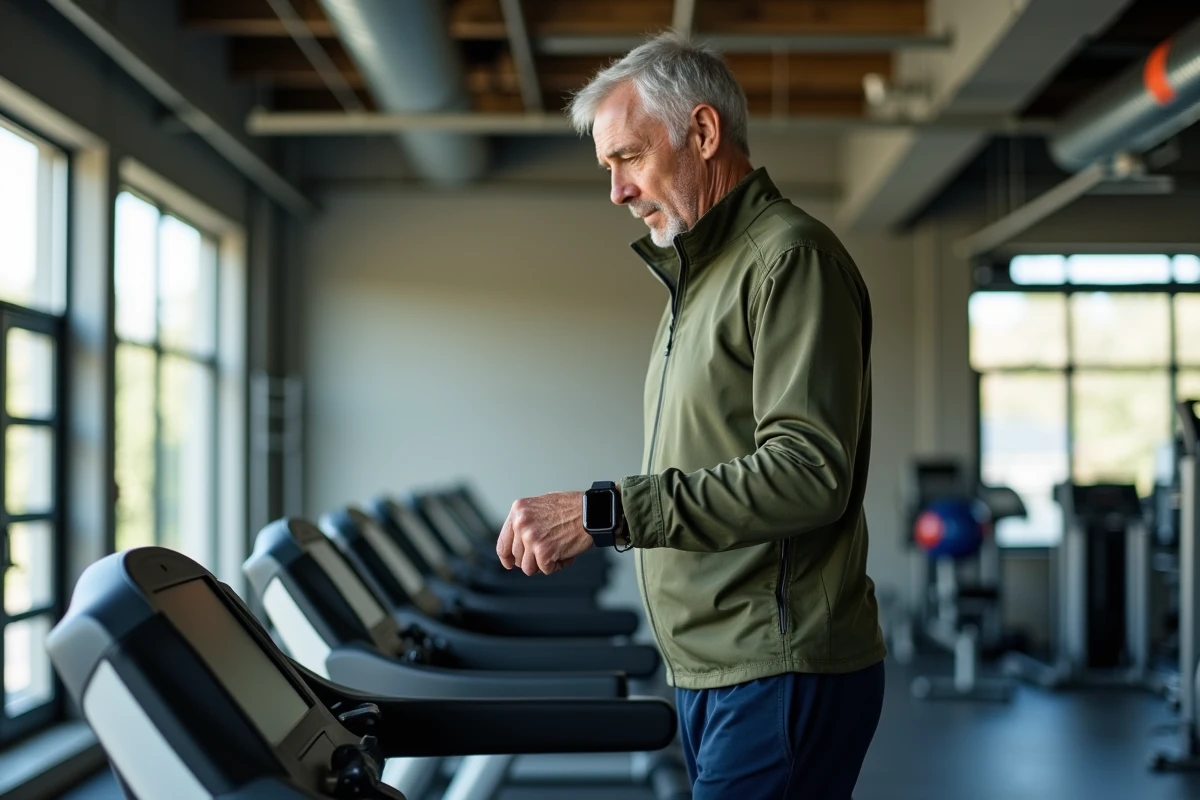
During moderate walking, heart rate generally falls between 50 and 70% of the theoretical maximum heart rate. During fast walking, it rises between 70 and 85%. If your connected watch shows a cadence of 115 steps per minute but your pulse remains low, it’s a sign of good physical condition. Conversely, if the same cadence raises your heart rate above 85% of your maximum, the intensity is too high to be sustained long-term.
The combination of both data (cadence and heart rate) allows for precise calibration of effort. An effective fast walking session combines a sustained cadence and a stable heart rate within the target zone, maintained for at least thirty minutes.
Nordic walking vs. classic fast walking: measurable differences on the body
Moderate cadence Nordic walking (around 110 to 120 steps per minute) surpasses classic fast walking on one specific point: the activation of trunk stabilizing muscles. The amplified swinging motion of the arms, made possible by the poles, engages the obliques, lats, and deep pelvic muscles in a way that walking without poles does not replicate.
In postmenopausal women, clinical observations over 12 weeks of regular practice show a trend towards a decrease in systemic inflammatory markers with Nordic walking. This anti-inflammatory benefit has not been observed to the same extent with fast walking without poles.
- Nordic walking mobilizes about 90% of the body’s muscular chains thanks to the active push on the poles, compared to a significantly lower proportion in classic walking
- The amplified arm swing improves thoracic posture and reduces frequent neck tension in people who work seated
- The use of poles decreases the load on the knee joints, making this practice accessible to overweight individuals or those in rehabilitation
In contrast, classic fast walking requires no specific equipment and can be practiced anywhere, making it easier to integrate into daily life.

Improving walking speed: three concrete technical levers
Increasing walking speed is not just about pushing the pace. Three biomechanical parameters determine progress.
Stride length is worked on from the back, not from the front. Lengthening the step by placing the foot further in front slows down the movement. Propulsion comes from the push of the back foot, with a complete roll from heel to toes. This technical gesture distinguishes sporty walking from daily walking.
Cadence improves through interval training. Alternating phases of fast walking (two to three minutes) and recovery phases at a moderate pace allows the body to adapt to a higher rhythm without exhaustion. This type of session, practiced twice a week, produces visible results in a few weeks.
- Amplify the arm swing, elbows bent at about 90 degrees, to synchronize the upper and lower body
- Keep the torso upright with a slight forward lean, without bending at the hips
- Work on ankle mobility to improve foot roll and propulsion phase
Data from post-stroke rehabilitation programs confirm that a gradual increase of 10% in walking speed over 8 weeks reduces falls by 30% in the affected patients. This protocol is precisely based on the amplified arm swing and the gradual increase in cadence.
Walking speed, far from being just a number on a screen, reflects the coordination between muscle strength, joint flexibility, and cardiovascular endurance. Measuring your cadence rather than counting your steps provides a more accurate picture of your physical condition, and focusing your progress on technique rather than raw effort yields more sustainable gains.